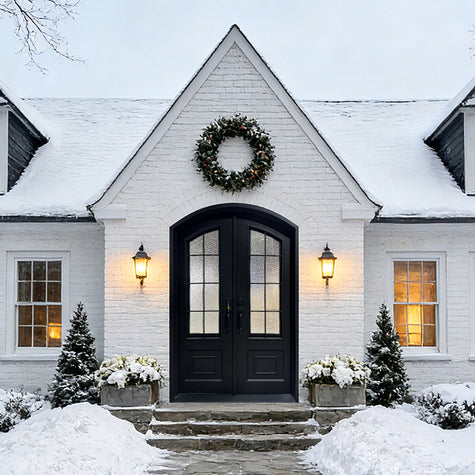
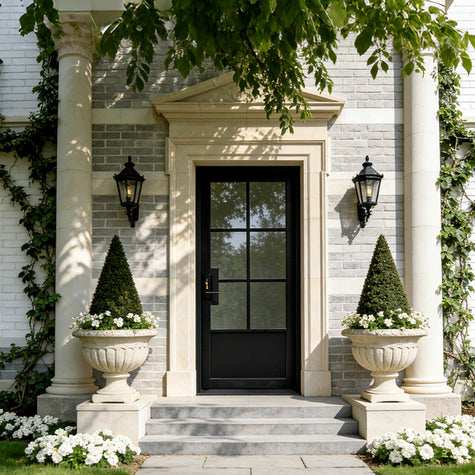
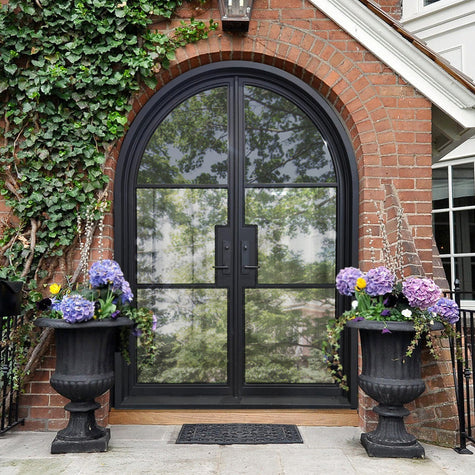

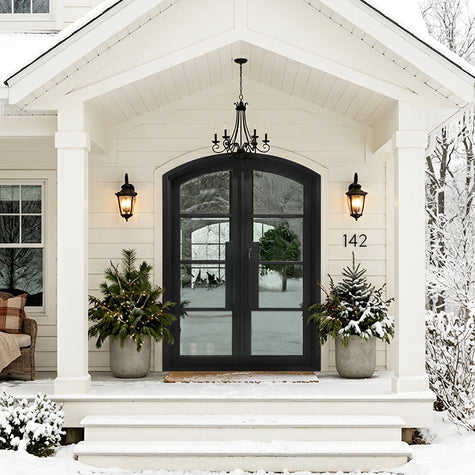


If you’re shopping for a new iron entry door, you may come across two common options: pivot doors and traditional hinged doors.
At first glance, the difference may seem simple—one pivots, while the other uses hinges. But the opening mechanism affects much more than that. It can change how the door looks, how much clear passage space you get, what hardware can be used, and which style works better for your entry.
Here’s a practical look at the differences between iron pivot doors and hinged doors.
What Is an Iron Pivot Door?
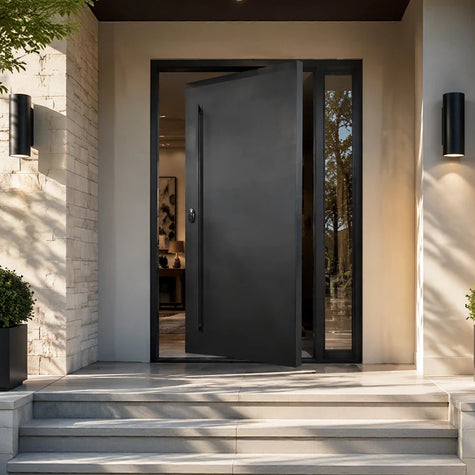
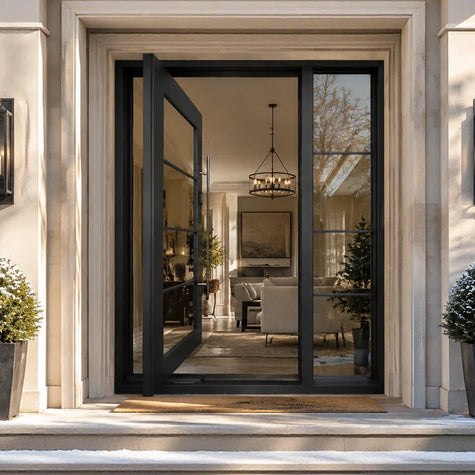
A pivot door rotates on pivot points located near the top and bottom of the door rather than on hinges mounted along the side of the frame.
Because the pivot point is set inward from the edge of the door, part of the door slab swings inward while the other portion moves in the opposite direction as the door opens.
This gives pivot doors their distinctive movement and allows them to work especially well with large, wide, or oversized single-door designs.
Visually, pivot doors tend to have a clean, architectural appearance. They are often used for contemporary homes, large entryways, and statement entrances where the door itself is intended to become part of the home's design.
Iron Pivot door:

What Is a Hinged Iron Door?
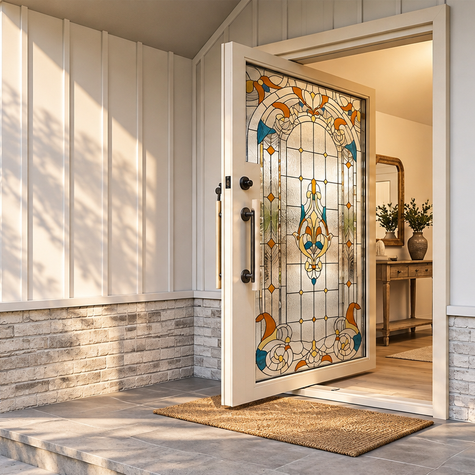
A hinged door is the more traditional configuration. The door slab is attached to one side of the frame with hinges and swings from that edge.
This is the system most homeowners are already familiar with.
Hinged iron doors can be made as:
They also work with a wider range of traditional hardware configurations and are generally a practical choice when maximizing usable opening space is important.
Hinged Door:

Pivot Door vs. Hinged Door: The Main Difference
The biggest difference is where the door rotates.
A hinged door rotates from the edge of the frame. When fully opened, almost the entire space between the frame and the open door can be used as passage space.
A pivot door rotates from a point located inside the door slab. This creates the signature pivot movement, but the portion of the door between the frame and pivot point remains within the opening.
That means a pivot door and a hinged door with the same overall unit width will not necessarily provide the same clear entrance width.
This is an important detail that can sometimes be overlooked when choosing between the two.
How Do They Look Different?
Pivot doors are often chosen for their appearance as much as their function.
The pivot mechanism makes it possible to create an oversized single door without relying on a conventional side-hinge layout. Large glass panels, simple iron frames, long pull handles, and minimal designs work particularly well with this configuration.
Hinged doors have a more familiar appearance, but that doesn't mean they have to look traditional. A hinged iron door can still have a very modern design with narrow sightlines, large glass panels, minimal grids, or a simple black frame.
The difference is mainly in the movement and proportions of the door, rather than whether one is modern and the other is traditional.
Hardware Is Different Too
The opening system also affects which hardware can be used.
Traditional hinged doors offer more flexibility when it comes to lock and hardware configurations. Depending on the door design, they can accommodate conventional handlesets, smart locks, deadbolts, and certain multipoint locking systems.
Pivot doors require hardware that works with the pivot mechanism and door structure. Some hardware options that work on a conventional hinged door may not be suitable for a pivot door. For example, our iron pivot doors are not compatible with multi-point locking systems and deadbolt, they may scratch the door frame.
If you already have a particular lock or handle system in mind, it’s a good idea to confirm compatibility before finalizing the door configuration.
Quick Comparison
| Feature | Iron Pivot Door | Hinged Iron Door |
|---|---|---|
| Opening mechanism | Top and bottom pivot points | Side-mounted hinges |
| Door movement | Rotates around an inset pivot point | Swings from the edge |
| Best suited for | Large or oversized single doors | Single, double, and French doors |
| Clear opening | Reduced somewhat by pivot location | Generally maximizes usable opening |
| Visual style | Architectural, statement-oriented | Traditional to contemporary |
| Hardware flexibility | More configuration-specific | Generally more flexible |
| Smaller openings | May reduce passage space | Often more practical |
| Large single-door designs | Excellent application | Possible, but depends on size and structure |
Pivot or Hinged?
The main question is how you want the door to function.
A hinged iron door gives you the familiar side-swing operation, makes efficient use of the door width for clear passage, and works well for single, double, and French door configurations. It also generally provides more flexibility when selecting locks and hardware.
A pivot iron door gives you a different opening motion and works particularly well when you want one large door slab to create a more architectural entrance.
The size of the opening can also play a part, but it doesn’t have to determine the choice by itself.
Explore Iron Pivot Door Designs
Considering a pivot door for your entrance? Browse our Iron Pivot Door Collection to explore available styles, custom sizes, glass options, and finishes.
If you’re considering both options, send us your rough opening dimensions and the door design you like. We can review the configuration and help determine how either option would work with your entrance. At Legend Iron Doors, both hinged and pivot iron entry doors can be customized based on the opening, design, glass, finish, jamb depth, swing direction, and other project requirements.